Showing posts with label commitment. Show all posts

Thursday, March 22, 2012

Woe Is Writer


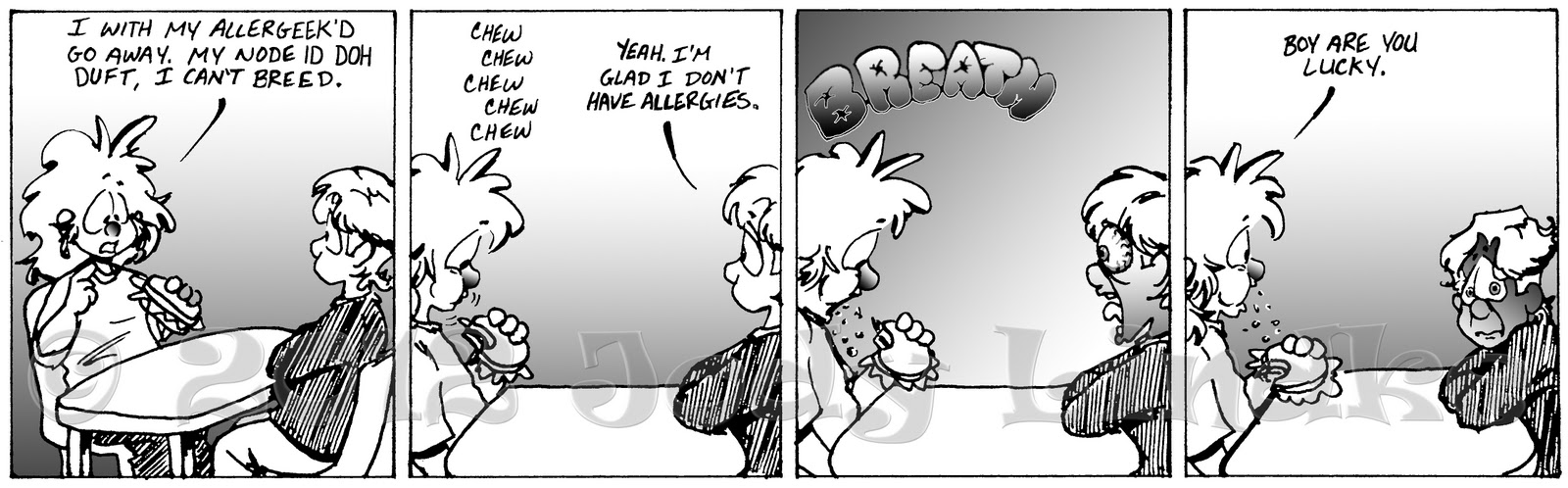
If writing were this easy and painless, I'd have completed whole libraries by now...

I recently read an article about boosting self-confidence with the power of positive thinking.  

How original -- snide remark compliments of my inner critic.

When it's on break from beating me to a non-productive, quivering pulp, my inner critic often amuses itself with wonderfully cruel asides.  It should blog...  Funny thing, the article knew my inner critic well and said the reason it's swelled to the limits of my skull is because I'm a girl.

"Another perk of womanhood!  Yay!"
--said my inner-critic.  I'm calling her Unis.  (The rest of me had a bit of an f.u. reaction...)

The article claimed that's because little boys tend to be criticized way more than little girls.  What?  I have no idea why that would be the case, but let's say it is.  The article claims boys criticize and tease each other more openly than girls, and anecdotally-speaking that does seem to be the case.  And it feels true that girls grow and nurture a substantially stronger inner critic than boys.  Just look at public restroom behavior.  En masse, women don't tolerate gross bathrooms or slovenly bathroom habits.  Men do.  Within 10 minutes any male public restroom becomes a post-apocalyptic mire pit.  Which I don't get at all.  Anyway, the article said because they're more used to criticism being heaped upon them, boys learn early to shake it off, confront it, or ignore it.  Which is why some can miss a toilet or sign their names in pee and go right back to their day.  Men who don't behave that way--often just hold it until they get home, if they are so able.  On the other hand, girls perceive criticism often when it isn't even really there.  We experience it more acutely, and internalize it, making it part of our identities.  A slovenly bathroom reflects on us, and we will not have that. We'll demand intervention, call in a manager, complain, the most fringe of our sex may even attack the mess themselves!

I don't know if the article was accurate, but it felt and feels true.  At least as a description of me and Unis.  And the inner-critic theory also fits with the "practice makes perfect" model.  Most boys and men I've known do seem better at ignoring, compartmentalizing or confronting than I am, all skills I'd like to master, though not at the expense of decent public bathrooms.  And I do dread a regular regimen of high-fiber frustration and cardio-criticism just to build my confidence muscles.

"Embrace your anxieties."

Shut up, Unis.


Friday, February 3, 2012

True Lies And Non-Fiction Fiction


I'm sure you've heard the phrase, "film is a lie at 24 frames per second."  Well, that's true, of course, because a film is not life, it's a construction.  Even a documentary cannot be anything other than a construction.  But in openly-admitted fiction that is in no way trying to be True, how much is true by necessity?

A common debate you'll hear throughout the humanities centers on how much of the artist is evident in the art.  How much of what's written is the writer?  There are whole schools of criticism that take up variations of that one question.  You can build a whole career in critical studies just exploring auteur theory.  Way back when, one of my professors (also a novelist) was deeply annoyed we (his idiot students) kept making assumptions about an author based a novel he wrote.  For instance, one of the characters was quite perverse which prompted our creative interpretations of what the author believed about sex and women and sundry accoutrements.  The discussion got pretty detailed, and gross, and my professor ended up throwing a chair to get our attention back.  

I had yet to brave the admission I was, myself, a writer.  Publishing cartoons and writing all the time were my hobbies and side-lines, things I knew I would do for the rest of my life, but only in addition to a real career.  Because no-one writes books or draws cartoons for a living.  Those rare exceptions I saw in the newspaper or magazines or bookstore were freaks of nature or products of nepotism or luck.  They were not regular, real people from no-where like me.  Regular, real people from no-where go into law or medicine or other linear careers of easily measured success (apologies to the lawyers, doctors, and others laughing at me right now, but  these were the assumptions of my juvenile mind).  I had not yet faced the fact that I was headed for a creative career, so I didn't yet realize having any sort of audience meant I, too, was going to have to brave being exposed.  As a multi-panel cartoonist, I joked I was a "stripper" by trade.  I didn't realize at the time how very accurate that would be.

Creating anything--even if you couch it in lies and call it fiction--is a kind of personal striptease.  Naturally, everything we "create" on some level reflects who and what we are.  Even intentionally avoiding subjects, settings, events, or characters from personal history is revealing.  No wonder it's such a daring and nerve-wracking thing to do.  I get nervous as bathing-suit weather approaches, I certainly don't feel any more confident showing my insides as well as my outsides.  When I started considering a creative career, I engaged in ridiculous fantasies to keep myself hidden.  I'd write under pseudonyms, use caricatures instead of photos of myself, hire an actor to stand in for me at public functions:

"And the award goes to...Jody Lindke.  Playing Jody this evening and accepting on her behalf, please welcome Vin Diesel." 

What's almost worse than feeling so self-conscious is the counter-impulse of feeling supremely vain.  Creative expression strikes the insecure me as a narcissistic act of screaming on paper, "look at me!"  My inner-critic is fat and happy as it goes to town mixing low-self-exteme with guilt-generating shame, and the result, I've discovered (as it was recently pointed out to me again) is I chronically hold back in my work.  


I'd been dealing with rejections and couldn't help asking myself over and over "what do they want?"--they in this case being publishers and producers and agents and readers and every level of gate-keeping in between--and I did this within hearing of a friend who reminded me, "what they want, really, is a piece of your soul."  Did you feel a chill?  'Cause I sure did.  If I didn't want to share my visage with others, I certainly didn't feel any more confident exposing any fraction of my soul to derision.  I wasn't gonna do it.  There had to be a way out.  I had to be able to pretend convincingly enough to keep myself separate--and safe--and still create compelling fiction and films.

Not so.  

Looking at the stories I revisit most, the shows and films and books I turn to, I realized it's not only true, that bit about the soul, it's right that it's true.  It is just.  It is good.  


It's also really, really, really intimidating...

Whether you're consuming art or creating it, you're engaged in an act of sharing, and what you're sharing is yourself, your humanity--y'know, that thing supernatural or immortal creatures always envy in us, that thing we always recognize in friendly aliens from other worlds and never find in the ones who want to eat us.  That thing is what makes a good story great, that makes us laugh and cry and feel we not just engaged with art but experienced it.

I thought I was done with a particular bit of fiction.  It does all the things it needs to do.  It's funny, it's moving, it's got a plot, plants have pay-offs...but some parts feel clipped, some opportunities lost, because I'd approached it as a story about "those people" in "that place," and kept myself away from it.  So what could be great is only good.  If I dig in and let that bit of soul I've been hoarding show, if I scrape down to expose the raw, real emotion and pain of what I'm writing about, it could be one of those stories you can't look away from or forget, the kind of story that becomes as real and personal as lived memory.  Drama is action driven by feeling, and I hadn't wanted to feel what drove the actions I'd written about.  I'd written about death and fear and lust and love and joy, but I'd protected myself, kept my clothes on, kept my humanity to myself.  It's intimidating to think of an audience seeing this and saying, "this is Jody's fear and lust and love and joy," reducing me to what fragments of myself slipped through.  I don't want the censure or humiliation.  If I invest myself and the work is rejected, I lose the self-soothing, "well, that wasn't really me."  However much I give any piece of writing, it is by nature a construction, but if I only ever play it safe, my work can never be more than artifice.  

Striptease may be an art, but making art is a striptease.  You can't hide and create. 

I often say story lets us live surrogate lives, but I realize now that's only possible when the teller is courageous enough to give real life to it.  That bit of soul they want is where Truth with the capital "T" resides.  Art doesn't give us feelings of strength or courage or empathy or solidarity or love or loss or hope.  Art stimulates real feelings because real feelings were put into that art. Feeling is the heart (note the phrase) of story.  That's what gives it the power to teach, to reveal our humanity, to cement our connectedness and acknowledge our fragility.  Dismissing it by calling it "fiction" is kind of naive.


Wednesday, January 25, 2012

Killing Babies with Pilar Alessandra

Our honeymoon was a spectacular and rather spontaneous road-trip up the Pacific coast that almost crossed into Canada except the money ran out and we beat it back home in a single marathon drive praying we’d make it and running on fumes.  But before the coffers went from crinkle to jingle, we spent a few days walking the entire city of Seattle, which closes promptly at four p.m., and stopped in at the Seattle International Film Festival.  Didn’t even know it was going on until we got there, and how perfect for a pair of flick-philes?  We shocked the Canadian-adjacent by tipping for our frothy coffees and sat down for an epic viewing session that included Ulysses Gaze.

If you find yourself facing the end of your life, consider spending your remaining time watching Ulysses’s Gaze.  It will be the longest four and a half hours you’ve ever experienced.  Feel free to drink loads of frothy coffee, too, for while the filmmaker provides about a half-dozen perfectly satisfying endings, the film truly goes on forever.  You can escape for a potty break or a scone or what have you without missing any action whatsoever.  When you hit the melancholic journey by barge with the huge stone head of Lenin, you have oodles of time to step away and come right back to enjoy (believe it or not) at least a quarter hour of slightly different angles of that same rocky noggin.  We didn’t know that at the time.  We don't usually walk out on movies, no matter how bad.  They’re not easy to make and almost always have some redeeming quality somewhere.  So though we squirmed miserably after drinking (apparently) way too many coffees, we concluded they had to still be filming Ulysses’s Gaze and simply streaming the raw footage into the theater as we sat and suffered.  (It did feel that unedited at the time.)

I don’t mention the flick to bash it to bits.  As I said, if you have only four hours, that’s one way to really stretch ‘em out!  But it’s an object lesson in failing to do the work of creative production, what some call “killing your babies.”  When you get too precious about your film or your writing or your cartoon or whatever, you lose objectivity.  The result can be “creative masturbation,” which sounds a lot racier than what it is.  Remember in Meet Joe Black when the young couple who just met over coffee part ways and look back at each other something like seventeen times?  At some point, it’s just too much.  SPOILER ALERT—just run Brad Pitt over with the car already, the scene ended six minutes ago!  You know that feeling.  Maybe you’re reading a novel or watching a movie like A.I.—over and over you get that sense of natural resolution but the yarn spins on and, when it's a movie, 100 minutes of awesome become a 260 minute exercise in bladder control.

This comes to mind because I did indeed find ten minutes to commit to one of Pilar Alessandra’s Take Ten exercises.  I have to say, I like the book so far (I’m up to page 8 now!), I love the idea that it’s possible to crank out a sound screenplay working ten minutes at a time, but the key to Pilar’s book and prompting questions is, as is often the case, the hardest part of creating anything:  making decisions and sticking to them.  It isn’t difficult to write a screenplay.  What’s beat-your-head-against-the-wall difficult is writing only one.  I don’t know about you, but writing on any one story always triggers creativity in at least a half-dozen other directions.  Right now, I have the project I’ve begun, two novels I’ve been toying with, a feature I that wants revising, and two others I haven’t started yet.  All are populated with characters who clamor for my attention and the narrative spotlight.  They distract me with great dialogue totally inappropriate or irrelevant to what I’m working on.  And the most frustrating thing is if I submit and turn the spotlight on any other project, those chuckle-heads scatter and everyone else chimes in.  It makes getting to sleep a serious challenge.  On the other hand, I’m rarely lonely.
And maybe just a skosh mentally ill as I read that back over…

One tight screenplay detailed enough to surprise and stand out and structured with the precision of a Swiss watch—that’s the goal, that’s what gets budgets and green-lights and movie-goers to open their wallets and fork over that especially-hard-earned cash.  And it’s really f-ing hard to do. 

Deciding is easy.  Being creative is easy.  But committing to it, knowing when to leave it alone—for me, that’s the toughest part of writing anything.  The curse of spec-writing is the soft deadline—self-defined and too often lenient.  The second best part of working for hire (just under getting a paycheck on delivery) is never having to let go of a project because the Suits who cut the checks rip it right out of your hands.  Then it’s on to editors or publishers or studios or directors or production companies to torture themselves with how to cut sixty-eight shots of circling Lenin’s head by helicopter.  Seriously, pick two and move on!

So, Take-Ten exercise one--focused on the main character (Pilar calls it the MC--already sparing me a big stalling habit I have of obsessing about names--I've wasted days worth of valuable writing time trying to name a character that needed, let's face it, a great deal of work on a few other little areas, like the plot) and the basic points--what's the problem and what's MC do about it.  Amazing how sticking to the basics and just focusing for ten minutes can really help you cut the hooey and get to work.