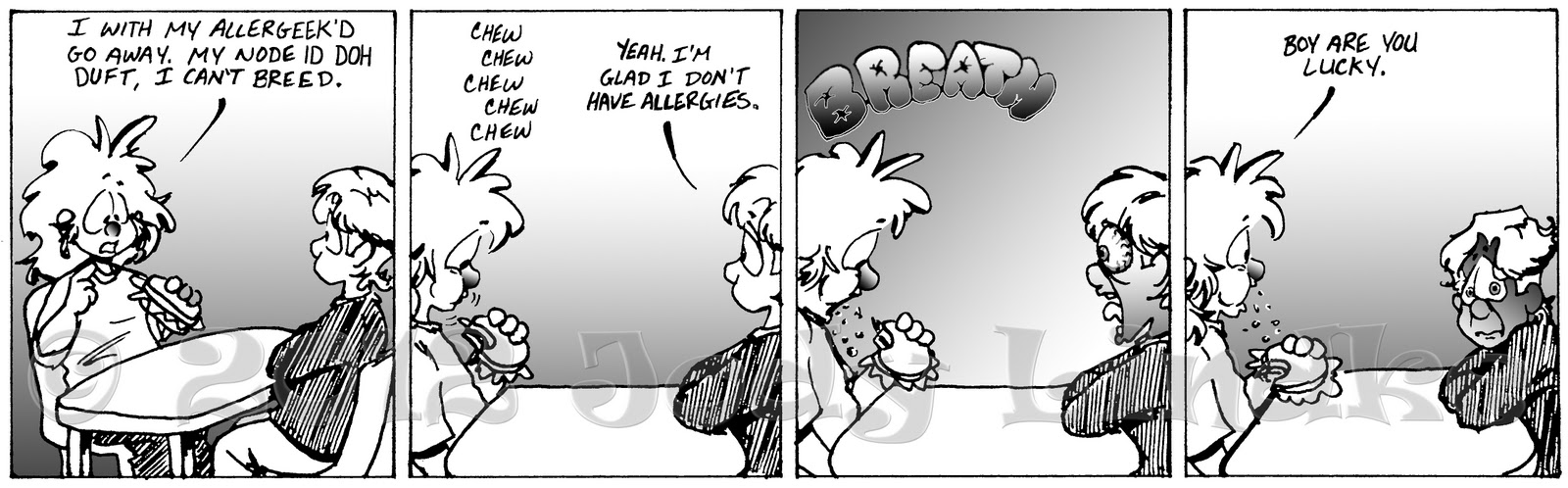
Showing posts with label cartooning. Show all posts

Monday, November 5, 2012

PiBoIdMo and 30 Todays


This past weekend ended daylight savings time (or began it?  I forget), and our household "fell back" an hour, earning (one would think) an extra hour's sleep.  But we have preschooler twins, so our extra hour turned into a just as early but extra long morning.  And I have to say, it was sublime.  Spending time with brand-new or nearly new people is a fantastic way to see the world with renewed eyes.  It's also completely exhausting, but despite that exhaustion, new people are inspiring, and my new people are making me better at the things I thought I was already doing kinda well.

Case in point:  The PiBoIdMo Challenge.  Once informed, I immediately said, "Yes!  I will do it!"

What is the PiBoIdMo Challenge?  Well, for real and specific details, you can check out Tara Lazar's site where she explains it.  In short, the goal is for participants to come up with 30 ideas for 30 children's picture-books in 30 days, making November a kind of national Picture Book Idea (PiBoId) month (Mo)!  I also find it a wonderful "keeping-writers-motivated-through-the-holiday-grind" challenge, and I can't thank Tara enough for sending out the mass invite.

My twins inspire a great many picture book ideas, and they often enjoy telling me lengthy yarns of their own, more often than not featuring their "brothers" Iron Man, Superman, and Captain America, and their sisters (or sometimes alter-egos) Hello Kitty and her twin sister Mimi (also "Boxy" in our house).  It's spectacular, and fun, and the cruelty of it is by the time they're in bed or I have access to a pad and paper, I'm so bleary-eyed from the day I can hardly remember my name (or to take the keys out of the front door lock, or to take the milk out of the cabinet and put it in the refrigerator where it belongs), let alone recount or even short-hand the cool, funny, and remarkable sayings, ideas and tales of the day.

Tara's great gift to me this November is to commit me to writing at least one down.  I wake up in the morning with that goal in mind, I hold onto it like a lifeline in raging waters throughout the day, and when an idea--ANY idea, as with a goal of 30, they don't all have to glow in the dark!--solidifies enough to form words, I scratch it down so at the day's end I can decipher my harried scrawl and translate it to an actualized, fully-formed book concept.

Today is the fifth.  So far, I have not missed a day.  While I began this blog with the intention of posting once a day, then once a week, then blinked and months sped by, I do believe I'm up for this 30 day November challenge.  And with a recently received writing rejection under my belt--a real one that took energy to apply for and months to receive--I believe in myself as a writer.  And with remarkable twin preschoolers lighting up my days, I simply believe in me.  Today, at least. 

To extra-hours and longer mornings.  

To exhaustion by preschoolers.  

To 5 down and 25 todays to go!
 

Monday, May 7, 2012

Thursday, March 22, 2012

Woe Is Writer


If writing were this easy and painless, I'd have completed whole libraries by now...

I recently read an article about boosting self-confidence with the power of positive thinking.  

How original -- snide remark compliments of my inner critic.

When it's on break from beating me to a non-productive, quivering pulp, my inner critic often amuses itself with wonderfully cruel asides.  It should blog...  Funny thing, the article knew my inner critic well and said the reason it's swelled to the limits of my skull is because I'm a girl.

"Another perk of womanhood!  Yay!"
--said my inner-critic.  I'm calling her Unis.  (The rest of me had a bit of an f.u. reaction...)

The article claimed that's because little boys tend to be criticized way more than little girls.  What?  I have no idea why that would be the case, but let's say it is.  The article claims boys criticize and tease each other more openly than girls, and anecdotally-speaking that does seem to be the case.  And it feels true that girls grow and nurture a substantially stronger inner critic than boys.  Just look at public restroom behavior.  En masse, women don't tolerate gross bathrooms or slovenly bathroom habits.  Men do.  Within 10 minutes any male public restroom becomes a post-apocalyptic mire pit.  Which I don't get at all.  Anyway, the article said because they're more used to criticism being heaped upon them, boys learn early to shake it off, confront it, or ignore it.  Which is why some can miss a toilet or sign their names in pee and go right back to their day.  Men who don't behave that way--often just hold it until they get home, if they are so able.  On the other hand, girls perceive criticism often when it isn't even really there.  We experience it more acutely, and internalize it, making it part of our identities.  A slovenly bathroom reflects on us, and we will not have that. We'll demand intervention, call in a manager, complain, the most fringe of our sex may even attack the mess themselves!

I don't know if the article was accurate, but it felt and feels true.  At least as a description of me and Unis.  And the inner-critic theory also fits with the "practice makes perfect" model.  Most boys and men I've known do seem better at ignoring, compartmentalizing or confronting than I am, all skills I'd like to master, though not at the expense of decent public bathrooms.  And I do dread a regular regimen of high-fiber frustration and cardio-criticism just to build my confidence muscles.

"Embrace your anxieties."

Shut up, Unis.


Friday, March 16, 2012

Screw The Devil You Know


For the longest time, I feared a creative career would make me hate being creative.  I'd heard authors and artists complain bitterly about compromising their vision or bowing to market pressure or client whims, or having to spend all their time making only one kind of thing which limited their time to explore other kinds of things.  Selling creative product corrupted their joy.  

I was terrified of that.  Of losing art.  Losing the joy of creating.  It's very personal and satisfying and self-indulgent to tap the imagination.  A person can do lifetimes of living deep within. 

What would I do if art and language ceased to delight?  The very notion is unbearable.  I don't mean to be melodramatic about that, but it is.  Unbearable to lose that passion, that escape, that huge component of my identity.  And because I worried so much that a creative career would corrupt my enjoyment of it, I kept it to myself and working was only a means of supporting my creative habit.  Art was my fantastical plan C or E or Q.  It wasn't something you do for a living, it's what you do after you get home from doing what you do for a living.  Art is for evenings and weekends and to be set aside before the rigors of a real work day.  

I worked and I created and I didn't sleep much, and all the while I secretly hated myself for giving it up like that.  And I resented any intrusions into my creative "free time."  I harbored anger, I nurtured dread, and I fed my inner-critic to bursting.  But the Devil you know, right?  At least going without art most of the time spared me the possibility of going without forever.

I worked a wide variety of jobs, putting in sometimes twelve hour days just to race home clinging to whatever kernel of an idea I was attempting in the hope I could execute it before exhaustion set in.  Road Crew was among the more vivid as it involved scraping up road-kill, repairing guard rails, digging ditches, washing trucks, laying asphalt, applying hundreds upon hundreds of those little yellow reflectors...  It may sound strange, but clearing culverts and rotting street-meat remains one of my most favorite support-my-writing-habit jobs.  It was physical and demanding and my brain was my own most of my time.  I could re-direct traffic and still write in my head all day long.  I could be there, and not be there at the same time.  It was great.  On the other hand, that's also a recipe for getting run over.  Happily, I didn't.   

Now that I have children, I look back on "my youth" in awe of the vast quantities of "free time" I had at my disposal and wonder, "why didn't I do more [enter any fun or productive pass-time]?"  I didn't vacation, I didn't party, I didn't entertain friends much or tackle my increasingly long list of hobbies and activities I'd like to get to one of these days.  Instead, I hoarded and funneled what time I could into my real work, my life's work, my raison d'etre.  I learned, I wrote, I drew.  Effort and inspiration poured out of me in sporadic, undisciplined bursts, often stalling out or switching projects as energy came and went.  Then back to work to earn scratch enough to keep buying supplies, to keep dreaming.

I don't know exactly when I started to really care about including others in my dreams.  I know I did care, right from the start, but at some point it became an actual goal, sharing with others.  It wasn't enough to make something, I wanted that something to be seen and felt, I wanted to engage with others, to be heard and to listen.  Maybe I grew up a little.  I realized I'd sabotaged years of creative productivity by wasting years' worth of available productive hours on irrelevant labors and being afraid of losing something I couldn't actually separate from myself if I tried.  I'm an artist.  I'm a writer.  I can't not be, I don't know how.  Thanks to a collection of odd jobs, I do know how to do a ton of other things.  I console myself saying these experiences all feed the writing, they all inspire the art, but I'd rather have that time back.  If I had it, I'd probably write a better post.  

On the other hand, I don't know if I'd have thought of the cartoon...

Friday, February 10, 2012

Family Ties and Bindings


I know a very talented composer/song-writer.  Like so many in the music biz who blow my mind, he is versatile and able with a whole mess of instruments and can, all by himself, compose, arrange and record a full score's worth of music all by himself, playing every part, with a little home-recording equipment and mixer.  Amazing.  Because he insists on having ridiculous extravagances like uninterrupted health insurance and paying his bills in a timely manner, he teaches and manages in addition to composing, but he longs for a day when he a score gig, theme-song or recurring jingle pays well enough that he can devote his working days to music full time.  

He landed a commercial, a national commercial, which doesn't equate to suddenly living in a beach house in Malibu but is, nonetheless, a monster big deal, especially to those of us still on the breaking-in side of any creative industry.  He excitedly shared this fantastic news with his family, explaining that he'd sold an original song that would then be recorded and played, nation-wide, on multiple channels, etc.  Very exciting stuff.  Through it all, his mom uh-huhed and smiled and listened, and then said, "I don't see how this makes you money, though."  He explained again about copyright and pay-per-play and rates varying by channel and exposure and repeated play.  "Uh-huh," she said, still confused.  "But why do they pay you for that?"


His big news fell like a stone.  It was kicked around a little through dinner.  Finally, he stopped trying to make his mom understand not only that he would earn money every time the song was used but that he deserved to be paid for each use.  He returned to SoCal and LaLa Land  a little heart-broken.  


Family is such a funny thing.  Nothing means more or is harder to get than a ringing family endorsement, and no rejection by colleagues, friends or strangers stings quite like an unenthusiastic, "it's nice but--" from a relation.  It's especially problematic when your work is outside the familial expertise or taste.  Help-books and friends tell you to harness these feelings, channel them into your work, because they are potent and real and universal, feelings rooted in the deepest love and respect --

These are the feelings that make lifelong careers!  

For therapists.

ba-dah-dah-dah!

Thursday, February 9, 2012

Hero of My Own Story--Sort Of...

 
Whenever I'm cleaning up or putting away or scraping poo off my daughter's rain boot, I try to remember I am the hero of my own story.  This is my saga.  My time is now!  So is yours.

Wednesday, February 8, 2012

Art, With a Big "A"


I doubt it's as easy to be a critic as I like to think, but it's certainly easy to criticize, especially ourselves.  So many times I catch myself side-tracking my creative process with concerns that what I'm doing or making or writing or drawing isn't good enough without batting that self-destructive question back to my inner critic (which is where all such stupid questions originate) with a "good enough for what?"  Another good follow-up is for whom?

If you love art and the Arts (with a big A), it can be easy to confuse your creative process and what you do with sum total greatness of the greats who came before you.  If you're really hard on yourself, you'll even pretend Rembrandt and Keats were not beholden to market factors like finding funding, reaching the right audience, and paying rent.  

None of them--let me say that again because it's important and bears repeating--NONE WERE GREAT FROM THE START!  Every great artiste drops some pretty stinky bombs on occasion, some which sell and some that don't.  And they all have to eat.

Even the jokers who had patrons a-plenty in their pockets, the ones who slept with all the right people or had perfect raw talent straight out of the womb, even they (and I've no idea who I'd be talking about now) self-censored, catered to the tastes of others, were frustrated by the limits of their own talent and materials, prayed for more or less time, better inspiration, faster results and more efficient productivity.

Art does not begin as Art.  It doesn't typically finish as Art, either.  It starts small, sometimes as only a fraction of an idea or feeling.  Sometimes it's allowed to find its way like a child in the woods, learning and evolving as goes.  Other times, like a child in the woods, it gets battered or eaten, its remains found by the child-ideas tripping along behind it, who then run back to you shattered and scarred...  


Maybe not the best simile.  

I sometimes hear people say movies or television are so formulaic.  

"Oh, snore.  That's so predictable."  

Well, of course it's predictable.  Shakespeare is predictable.  You knew it was predictable, you wanted it to be predictable, that's why you chose to be an audience in front of a screen or stage instead of doing extreme sports or taking over a small country or whatever else you might've done during that time.  The trick (and if you can pull this off in your writing, your audience will love you forever) is to wed predictability with freshness.  Part of the delight of experiencing art (and the skill involved in making it) is when something absolutely predictable still manages to surprise.  But if you write within the genre, the patterns and structure will still be there.  There will be a beginning.  There will be a problem.  It will get complicated.  After significant struggle, there will be a resolution, often from some seemingly minor detail you remember from waaaay back at the beginning.  And when it's over, you'll feel smarter than the formula but satisfied your expectations were met.  After all, it's not free-form space-jazz accompanying alien performance art you're viewing, it's mass-market entertainment, and if it didn't hit your specific yippee-button this time or alter your very existence, tough nuts.  That's your job.  That's called living.

If you're an artist or a writer, the last thing you should think about is whether or not what you're making is Art.  At minimum, it is art, no question, so start there.  Focus on the purpose, on the idea, on the thing itself, and if that means focusing on the deadline or the frame or the project specs or the forumula, do that.  Because everything that ever went from art to Art first had to be made.

Tuesday, February 7, 2012

Try This


It's the year of the black water dragon, and I'm trying new things.  Like applying my skills to self-promotion and networking, reconnecting with the old, introducing myself to the new.  Like writing every single day, even if the result isn't worth the virtual page it's printed on.  Like getting up an hour early to get my behind to the gym.

Yep, did that today.  Yep, was awesome.  Yep, feel like a super-something-awesome and the endorphins are only just now wearing off.  Here's to the year of the dragon and not letting life get in the way.

Friday, February 3, 2012

True Lies And Non-Fiction Fiction


I'm sure you've heard the phrase, "film is a lie at 24 frames per second."  Well, that's true, of course, because a film is not life, it's a construction.  Even a documentary cannot be anything other than a construction.  But in openly-admitted fiction that is in no way trying to be True, how much is true by necessity?

A common debate you'll hear throughout the humanities centers on how much of the artist is evident in the art.  How much of what's written is the writer?  There are whole schools of criticism that take up variations of that one question.  You can build a whole career in critical studies just exploring auteur theory.  Way back when, one of my professors (also a novelist) was deeply annoyed we (his idiot students) kept making assumptions about an author based a novel he wrote.  For instance, one of the characters was quite perverse which prompted our creative interpretations of what the author believed about sex and women and sundry accoutrements.  The discussion got pretty detailed, and gross, and my professor ended up throwing a chair to get our attention back.  

I had yet to brave the admission I was, myself, a writer.  Publishing cartoons and writing all the time were my hobbies and side-lines, things I knew I would do for the rest of my life, but only in addition to a real career.  Because no-one writes books or draws cartoons for a living.  Those rare exceptions I saw in the newspaper or magazines or bookstore were freaks of nature or products of nepotism or luck.  They were not regular, real people from no-where like me.  Regular, real people from no-where go into law or medicine or other linear careers of easily measured success (apologies to the lawyers, doctors, and others laughing at me right now, but  these were the assumptions of my juvenile mind).  I had not yet faced the fact that I was headed for a creative career, so I didn't yet realize having any sort of audience meant I, too, was going to have to brave being exposed.  As a multi-panel cartoonist, I joked I was a "stripper" by trade.  I didn't realize at the time how very accurate that would be.

Creating anything--even if you couch it in lies and call it fiction--is a kind of personal striptease.  Naturally, everything we "create" on some level reflects who and what we are.  Even intentionally avoiding subjects, settings, events, or characters from personal history is revealing.  No wonder it's such a daring and nerve-wracking thing to do.  I get nervous as bathing-suit weather approaches, I certainly don't feel any more confident showing my insides as well as my outsides.  When I started considering a creative career, I engaged in ridiculous fantasies to keep myself hidden.  I'd write under pseudonyms, use caricatures instead of photos of myself, hire an actor to stand in for me at public functions:

"And the award goes to...Jody Lindke.  Playing Jody this evening and accepting on her behalf, please welcome Vin Diesel." 

What's almost worse than feeling so self-conscious is the counter-impulse of feeling supremely vain.  Creative expression strikes the insecure me as a narcissistic act of screaming on paper, "look at me!"  My inner-critic is fat and happy as it goes to town mixing low-self-exteme with guilt-generating shame, and the result, I've discovered (as it was recently pointed out to me again) is I chronically hold back in my work.  


I'd been dealing with rejections and couldn't help asking myself over and over "what do they want?"--they in this case being publishers and producers and agents and readers and every level of gate-keeping in between--and I did this within hearing of a friend who reminded me, "what they want, really, is a piece of your soul."  Did you feel a chill?  'Cause I sure did.  If I didn't want to share my visage with others, I certainly didn't feel any more confident exposing any fraction of my soul to derision.  I wasn't gonna do it.  There had to be a way out.  I had to be able to pretend convincingly enough to keep myself separate--and safe--and still create compelling fiction and films.

Not so.  

Looking at the stories I revisit most, the shows and films and books I turn to, I realized it's not only true, that bit about the soul, it's right that it's true.  It is just.  It is good.  


It's also really, really, really intimidating...

Whether you're consuming art or creating it, you're engaged in an act of sharing, and what you're sharing is yourself, your humanity--y'know, that thing supernatural or immortal creatures always envy in us, that thing we always recognize in friendly aliens from other worlds and never find in the ones who want to eat us.  That thing is what makes a good story great, that makes us laugh and cry and feel we not just engaged with art but experienced it.

I thought I was done with a particular bit of fiction.  It does all the things it needs to do.  It's funny, it's moving, it's got a plot, plants have pay-offs...but some parts feel clipped, some opportunities lost, because I'd approached it as a story about "those people" in "that place," and kept myself away from it.  So what could be great is only good.  If I dig in and let that bit of soul I've been hoarding show, if I scrape down to expose the raw, real emotion and pain of what I'm writing about, it could be one of those stories you can't look away from or forget, the kind of story that becomes as real and personal as lived memory.  Drama is action driven by feeling, and I hadn't wanted to feel what drove the actions I'd written about.  I'd written about death and fear and lust and love and joy, but I'd protected myself, kept my clothes on, kept my humanity to myself.  It's intimidating to think of an audience seeing this and saying, "this is Jody's fear and lust and love and joy," reducing me to what fragments of myself slipped through.  I don't want the censure or humiliation.  If I invest myself and the work is rejected, I lose the self-soothing, "well, that wasn't really me."  However much I give any piece of writing, it is by nature a construction, but if I only ever play it safe, my work can never be more than artifice.  

Striptease may be an art, but making art is a striptease.  You can't hide and create. 

I often say story lets us live surrogate lives, but I realize now that's only possible when the teller is courageous enough to give real life to it.  That bit of soul they want is where Truth with the capital "T" resides.  Art doesn't give us feelings of strength or courage or empathy or solidarity or love or loss or hope.  Art stimulates real feelings because real feelings were put into that art. Feeling is the heart (note the phrase) of story.  That's what gives it the power to teach, to reveal our humanity, to cement our connectedness and acknowledge our fragility.  Dismissing it by calling it "fiction" is kind of naive.


Wednesday, February 1, 2012

Casting Vampires & Other Film School Cliches


It's awards season.  Festivals, viewer and professional award nominations are flooding the industry news, getting everyone excited and anxious to do new business.  For those in the rapids, congratulations and hang on tight!  For those on the shore, use the lull to gear up for next time.  And for those in between, do your best to stay afloat.  When it comes to scripted entertainment, sometimes just not going under deserves recognition and applause.

This season is always bitter sweet for me.  It brings to mind past projects:  the surprise when something you didn't realize was kinda good got some recognition, the suffocating silence when something you thought would do better isn't noticed at all.  It's a funny business.  

I had the great privilege of screening short films I worked on at festivals, at school, and at the DGA.  Like with writing anything, when you're involved in the making of a film, it's difficult to get the perspective and distance you need to actually see the film.  It's tough to see the edit for what it is when you're bogged down by memories of the making of the thing.  Maybe you can't see past the actor who seemed fine until he got drunk on set and felt-up half of your some-still-slightly-under-age, all-volunteer crew.  Or maybe you're stuck staring at the actress who swore she'd cut her hair to get the part but then refused half-way through production so the final third of the film doesn't make any sense.  Or the scene that should have had the hunky guy you already filmed for the plant scene but who didn't show up to shoot the pay-off, and you couldn't afford re-shoots so you never re-cast and what should have been a comedy isn't funny or even all that dramatic, so you're generally screwed.  Yeah, sometimes it's like that.


Like every department or component in any scripted entertainment, casting is crucial.  I won't say "casting is king" because we've all seen counter-examples and scripted entertainment, whether for the stage or the screen (of any size), is a team sport.  Quarterbacks and pitchers can't win by themselves, and a cast is nothing without a crew is nothing without a writer is nothing without a financier is nothing without...  Well, if financiers find themselves without, at least they have the means to buy it.  But I stand by the rest.  Back to casting.

It's a strange thing to be on the choosing side of casting.  I feel a little unambitious admitting I never used the "casting couch" as an opportunity to fleece someone for money or favors or to solicit border-line illegal "personal contact."  Talk about lost opportunities, right?  I found it challenge enough to just be at that table because I know what it's like to be on the other side.

There are many, many, many reasons I'm not an actor.  One biggie, I took theater in high school, where I learned that the anxieties typically associated with the audition side of a casting session pretty far exceed my anxiety threshold.  I'm always impressed when I meet (I'll add sane or happy) actors because what they do is really, really hard, and I don't mean performing.  Performing is an entirely different brand of difficult.  I mean auditioning, walking in cold, doing your thing (or their thing if there are sides), and walking out with no expectation of hearing from anyone, ever, about how you did or why you didn't get the job when you later see the film or show or program or commercial or print-ad or whatever.  That's really tough, and I find the people who can embrace that life and stress and remain whole with family and sanity intact are beyond remarkable.  Kudos. 

Though it is really important in film school to work on as many of your classmates projects as you can (every project is a massive learning experience and every crew position, no matter how unglamorous or seemingly unimportant, will teach you buckets about producing and getting the most from yourself and your work), one of the best things about film school was the push to make us cast real actors.  "Don't rely just on your classmates," soon became, "you will post ads, you will audition, you will cast real actors, or you will fail this class," and thank goodness it did, because nothing less would have gotten me to do it. 

There are several things you can expect to see in indie- and student films that scream cheap and cliche but which can be great if done with some exceptional flare or skill:  major scenes shot entirely on a couch, games of chess or prominently featured chess boards and pieces (often to indicate intelligence otherwise lacking in the character, writing, and film), protagonists running alone in metaphoric pursuit or metaphoric flight, over-use of close-ups, flat space, ridiculously severe stripy lighting justified by window blinds, no apparent ceilings coupled with obvious set-seams, twinkle-lights and generic neon signs...  Actually, it's a pretty long list and probably deserves a post unto itself.  Anyway, one of my shorts (prominently featuring too much flat-space, too many close-ups, and no ceilings whatsoever) embraced the reformed vampire cliche.  It's one of my favorites.  I don't like bullies or human predators, but I love a good redemption tale, and vamps typically have a lot to answer for.  

My film was about a latch-key kid who finds a vampire, knows what it is, and adopts him.  It doesn't end well.  Subtle, right?  Since vampires are heart-and-hand with sex and violence, I wanted to cast a very attractive grown man as my predator and a bright-eyed, prepubescent girl for my latch-key kid for added yet subtle tension.  Sh'yeah.  Okay, not subtle at all, but that's what I was looking for, and I tried to keep an open mind, and I found it!  The girl was terrific, inside and out, with a wonderful "stage mom" whose first and only priority was her daughter (not always the case with child performers and their moms).  For the vampire, I was torn between two actors.  One was fair, the other dark, one lanky the other beefy.  How to decide? 

When you're casting, you try to keep an open mind, partly because what you think you're looking for might not exist, and partly because preconceived tunnel-vision can blind you to discovering something great yet unexpected that an actor might bring to the role.  Every project lives for those moments, those hidden and inspired opportunities, and as a filmmaker and story-teller you struggle to keep yourself open enough to recognize them.  Both actors were easy on the eyes and willing to commit the significant time for rehearsals, shooting, sitting for mouth-molds so I could get prosthetic fangs made.  But one just had more of a "killer" vibe.  The other was a good actor, very personable, kind, smart, funny, with a terrific, easy-going smile that just lit up the room and made me (and by extension, would make my audience) want to know him more--a very charming guy.  I knew at once he'd be easy to work with even on long, long shooting days.  But the other guy--and it's magical when this happens in casting, when you stumble on that "it" factor, that "wow" moment where an actor just becomes or is exactly what you're looking for even though you didn't know until that very moment that's what you needed and wanted and can't do without--he just had this perfect and ominous je ne sais quoi that screamed "I'm a predator."  He was perfect. 

But when I prompted him later to improvise a scene where he's "cheering up a sad child" at, say, an airport or doctor's office, his same je ne sais quoi also whispered, "I might gut you between takes just to see the color of your insides."  And that was for "cheering up a child."

I cast the smiling Mr. Personable.  I was instantly rewarded by my instincts being confirmed.  He took the job seriously, was prompt and punctual and we got the prosthetic teeth molds and he was really supportive and friendly in the best possible way with the ten-year-old on set.  The prosthetic fangs were perfect and very believable in proportion, color and size.  Mr. Personable was so great, I was able to focus exclusively on the billion other problems that is shooting a student film, including re-writing the script almost from scratch mid-way through shooting because between lost locations and time there was no way what I wrote could be shot.  

Through it all, Mr. Personable smiled beautifully.  Because he couldn't not smile.  

Not even when he wanted to. 


This discovery was not made until dailies, which for this project meant half-way through production.  We'd shot the "temptation" scene, a dirty close-up of our killer face-to-face with the vampire-buffet that is a healthy little girl's pulsing throat.  He played it well, all in the eyes, and we could even see the flutter of her artery -- the shot really worked -- as his lips part and we see...no fangs.  Couldn't see the teeth.  Over and over, close-up after close-up, all burned film, all losses from budget and time, weeks of time and money in the one and only custom-prop, but not one shot, not once were the fangs visible.  Something I hadn't noticed about Mr. Personable until dailies was his mouth had a naturally smiling shape to it, lifting quite pleasantly at the corners, but also dipping slightly more than I anticipated from the corner to the mid-quarter of the lip, a dip perfectly suited not only to completely cover his incisors, but the extended fake fangs as well.

Back to set we went knowing what we had to do--maximize exposure of those fangs.  Without fangs, the character just looked like some creepy, pale guy following a ten year old girl home.  Without fangs, the tension was less predator vs. meal and more imminent child-rape, which is still evil vs. good in theme, but a noir of an entirely different shade and one I had no intention of re-writing to accommodate.  So, I laid it out, and he agreed -- we had to see the fangs!  

That's when we discovered he couldn't grimace.  The particular shape of his mouth and the development of his facial muscles which made him look so pleasant meant he could not sneer or snarl or bare his teeth in any menacing way to save his life.  And he tried.  He really worked at it.  Dude was totally committed to the role (and only working for copy and credit!  God, I love actors!), but he couldn't not smile, and teeth-gnashing of any kind was impossible.


Back went the fangs, priority rush, for modification.  Back to the edit bay, emergency panic, to figure out what was usable and what wasn't.  Back to the computer, frantic revision, because the film we started shooting wasn't possible, even with the changes we made to deal with the lost locations and time remaining.  Duly regrouped, we completed production...by embracing additional student-film cliches:  ridiculous make-up, over-use of music for lacking transitions, reveal-it-was-all-a-dream plot re-shuffle, and the classic we-can't-resolve-this-story-in-a-satisfying-way suicide ending.  

Obvious block-buster material.  It's how I made my first million.  [insert laughter here]

We finished it, the culmination of half a semester of overwhelming amounts of work and a life-threatening lack of sleep.  I think it's six minutes long.  Including the credits.   

Two years later, having finally saved up enough money to have my "negative cut" (this sucker was shot on real, physical film, mixed and screened off a telecined work-print), I enjoyed one final surprise student-film cliche:  lost negative.  Somewhere between the school and the film development house, exactly one reel of my film negative was misplaced, making it impossible to cut the negative and produce a finished film complete with (drum roll, please) optical mono-track sound transferred from hand-cut magnetic film!  Yeah!  

Personable as ever, Mr. Personable would've done re-shoots in a heartbeat -- a consummate worker and just that kind of guy.  But my latch-key kid went from ten to twelve, and in girl terms that's something like six inches taller, plus braces on her teeth--no way new footage would cut.  There ended any possibility of a formal screening, of festival submission, of cutting DVDs.  Not my favorite take-away from the student film-making experience, but a valuable lesson in blind trust, film storage and archiving.    
  
Aside from some seriously bitter disappointment at not being able to "time" and complete a finished print, I've never once looked back on this project and been sorry, especially about my cast and crew.  I got to shoot some stuff I'm really, really proud of, even if almost no-one will ever see it.  When I say I learned, I say it with major italics.  Ultimately filmmakers are just viewers who also happen to make films, so it's no surprise that what makes for a great movie or show viewing experience also makes for a terrific production experience.  Writers sometimes like to say, "it's an important story," or a "valuable tale," but good stories really boil down to the people in 'em, whether they're part of the action or the telling.  It's the people involved that make a story meaningful and the time communicating it well spent.  

I've gotten to work with some supremely kind and diligent people who gave their absolute all.  In this case, it was just to help tell a six-minute story pre-loaded with problems and cliches.  And it's still one of my favorites. 

Monday, January 30, 2012

Lizard-man With A Dash of Color


My, aren't we feeling visual today.  What is it?

Why, yes.  Thank you for noticing.  It's a lizard man.  With a toothache.  

I see.

Care for a dash of color?

Please.


Thanks.

My pleasure.  

How about a 'toon?

Certainly.


...just that kinda day...

Friday, January 20, 2012

What Goes Up...Keeps Going Up...

Why is it there's always some mean-spirited smarty-pants on any given set ready to mock the deeply-indebted for attending film school?  

"Film school?!  What a waste!  Shoulda just made your own film--costs the same and you'd learn more!"

Well, if you could borrow federal financial aid to make a movie, that might be true, but for me and most of my classmates "just doin' it" was never an option.  And actually runaway amateur productions can cost a lot more than a good film school, especially considering projects that fail to get proper insurance and lock up in litigation for property damage or on-set injuries.  And unless you're already stacked with industry connections, going it alone doesn't give you any particular access to the experience, advice and equipment film schools offer.  But on every set I've worked on, there was always at least one meanie eager to knock me down for believing in myself enough to take the leap and the monumental debt of film school.

It's not easy to work without sleep for "copy and credit" (and craft service meals, though they can sometimes be more threat than incentive), harder yet with people lining up to rub it in.  But every new business tends to lose money in its fledgling years, right?  So really, my 25 year mortgage with no home to show for it is a mark of professionalism.  A colorful aside for my 15-year "overnight success" story.


Boy, I'm looking forward to telling that in total!

Wednesday, January 18, 2012

Pre-emptive Fear Blows


Worrying is expensive.  It’s like emotional interest attached to any given event.

I don’t care how big or small, all features struggle with budget.  Whether you’re working with a hundred thousand or a hundred million, no budget ever seems like it can be enough, you’re always gonna struggle with costs, always going to push for more money. 

Getting a film financed has never been easy, but it’s particularly tough now with so much uncertainty in the US and world economies, especially since large-venue distribution (movie theaters) has steadily shrunk for as long as I’ve been alive.  Independent feature films not completely funded by pre-sales are a GIGANTIC financial gamble, but there are some hold-outs who do sometimes find the film equivalent of venture capital – cash with strings – and use it to make their films. 

I worked on one feature that had such funding but a big chunk of it was coming from a nervous source who stalled production day by day for weeks instead of releasing the funds.  Delays of any kind drive up costs, and this extended push lost the production some of its committed talent as their windows of availability closed and they went on to other projects.  The film was eventually a month past its start date and well over budget before a single frame had been shot—caused by the investor’s withholding of funds—and this only made that same investor even more uneasy to commit.

Can you say Catch-22?  Meanwhile, everyone held their breath and kept working, clinging to the hope they’d be able to pay their department employees and vendors.

Production finally started, but the financier insisted it stay within the original budget numbers, thereby eating the costs of the delay, and that meant there was no money for music.  At all.  None.  A script composed to modern published songs with references to at least one published song and shot in a way that begged a hip and trendy generation-defining collection of pop music to accompany its embedded array of meta- and pop-culture references—by necessity—went without.  It wasn't a silent film, all involved did their best "in post" to make do with little means and tied hands.  But the editing that needed music and sound design to help the scenes live and breathe, to punctuate performance, to build subtext or ease transitions – all that was sorely lacking.  It hurt the film, and it’s excruciating to see a hundred or more people give their all to something only to have it flounder.

Monday, January 16, 2012

They'll Get You!


I love horror stories – in theory.  Like in thumbnail form, interrupted by commercials on a muted TV during the day with at least four hours between final credits and sun-down. 

It’s not entirely my fault.  Fear and self-doubt are kind of constants with me.  Boost either one, I’m hyperventilating under the covers (because if even a toe is exposed, THEY’LL GET YOU!).  I know it’s ridiculous, but it feels true.  I guess I’m “highly impressionable” when it comes to horror.  Example?  The Original Star Trek episode “The Man Trap” had me leaping from my door to my bed at night throughout junior high lest the suction-cup-fingered, salt-sucking, shape-changer “get me.”  The first time I tried to read Dr. Jekyll and Mr. Hyde, I freaked out and threw the book under the bathroom vanity, where it remained for over three years before I forced myself to retrieve and read it.  Great book, but human malice, even fictionalized, really disturbs me.  In high school I wept uncontrollably through The Shining and spontaneously burst into traumatized tears again years later when I glimpsed a tiny fraction of The Shining embedded in the movie Twister – it’s what’s playing on the drive-in theater screen as the “finger of God” level five tornado rip the scene and screen apart.  Tornadoes, straight-forwardly threatening and therefore not scary.  Fathers carving up their families?  Simply terrifying.

But strip away the tension and gore, I love the genre.  Horror is rich in extreme characters and story lines and plot twists.  There’s little I enjoy more than a good horror-story re-cap.  As a kid, I did a lot of eavesdropping on the bus or quizzing friends to get the gist what horror movies or shows were out.  My husband often indulges me by re-telling the stories he knows I’ll otherwise avoid.  He doesn’t seem to view my shying from horror as a weakness.  But I do.

In film school, I stupidly decided to “push” myself instead of focusing on my strengths.  I shot a horror short film about a woman finding a dead body in her trunk only to realize she’d opened the wrong car…and the killer was still there!  It wasn’t very good, or subtle, and since what little horror experience I do have was viewed on “mute,” I didn’t realize until my classmates burst out laughing that I’d chosen the very distinctive score from Halloween, so it played like a parody.  The smart play would have been to pretend it was always a comedy, but I’m a terrible liar.  Instead, I accepted that horror was not my strength and chose a dramatic scene with an element of horror for a directing class.  Because practice makes improvement at least, right? 

Stupid, stupid, stupid me…

It didn’t help that without time to audition I went begging for actors, so the guys I cast had less than no respect for me and sort of resented the time-commitment.  The scene was one guy intimidating the other with status, which turns as the other offers a bodily threat of imminent, extreme harm while the dialog remains pleasant-sounding.  I loved the writing – tense, packed with subtext, rich language – plenty of room for an actor to play, I thought.  But my guys were grumps and I was beginning to think the whole thing was a wash when one got annoyed enough to do exactly what I’d been trying to get him to do.

Except he did it to me. 

Right in my face, a foot or more taller than me and something like fifty pounds bigger than I am (and all muscle in his case – ah, actors).  I don’t think his anger was real.  I’d pushed him and he was pushing me back.  But he could tear my arms from their sockets, and for a good 30 seconds, he made me believe he might.  He stirred all the fear I could ask for, and he knew it, and he smirked about it. 

As if scaring me instead of effectively performing with his scene partner proved he’s a better actor than I am a director.

Well, obviously he’s a better actor than I was a director, especially then!  The scene was for a class, and it was only my second directing effort EVER.  While he was supporting himself as professional actor and had been for a couple years already.  So when that merry Andrews had the gall to ask me if I was scared, I barked, “Who cares?  It’s easy to scare me!  Anyone can scare me!  Salt-sucking, shape-changers on Star Trek scare me.  I’m not in the scene, dumb-ass!”

Okay, I didn’t really say “dumb-ass” at the time.  Sometimes I think I’d really like to be one of those fearsome forces on a set who can do things like call big guys dumb-ass and reign them in with a blood-congealing glance, but that’s not me.  Thumper’s parental mantra “if you can’t say something nice—” rings like tinnitus in my ears.  But I did say the other parts, and he kind of listened and we finished rehearsing. 

I didn’t flunk the class, so I call it a success.  And actually, I didn’t cry in front of that guy.  I didn’t cry until I got all the way home.  So in that case, it was.  

Saturday, January 14, 2012

Does it Really Matter That...?

 
When the just-right-and-conveniently-available actor 
who has a fan-base and flare enough
to generate the buzz you need
to get a meeting
to pitch and sell
your sweated-blood-to-write original TV pilot

suddenly
lands a re-occurring role on some other show,

does it really matter that, 

"if water was whiskey and I was a duck,
I'd swim to the bottom and drink my way up" 

doesn't actually rhyme?


Saturday, January 7, 2012

About SPOILER ALERT! Bambi...


We have a very vocal apartment.  Our refrigerator occasionally wails a shrill, broken-hearted lament that sometimes goes on for quarters of an hour, our walls are thin, and our bathroom is a cacophony of water, pipe and pressure any time of day.  If you've ever done sound design, it's a great place to live.  Our twins soon took an interest in the sounds and their many suspected causes, but one day I was startled to notice one or the other storming around (they like to take turns with these things -- they're impressively fair about things like this) with crossed arms and bloody-murderous looks.  

"What's the matter?  Did something happen?" I ask.

"I'm mad!"

"I can see that.  You look mad.  What are you mad about?"

"No, I'm angry!"

"Oh, I see.  What are you angry about?"

After a moment of deep introspection, she'd announce, with a vehemence that trumpeted intolerable personal offense, "THE WATER IN THE PIPES!" and then go on storming and huffing and crossing arms with vicious expressions.

They were practicing.  I'm a youngest child, and I didn't recall ever seeing children practice feelings before.  I guess we'd managed a relatively conflict-free household up 'til then, because for months, typically on alternating days (to share), one would affect the pose and manner of outrage and go through the motions of being mad and talking about it.  It was really difficult not to laugh -- it was REALLY cute! -- but it was obvious this process was sincere and an important component of developmental emotional play.

Now, I'll admit to fast-forwarding Walt Disney's "Bambi" past the [SPOILER ALERT] mother's death scene, telling my girls simply, "it's time for Bambi to go spend time with his daddy now," and they still don't seem to mind.  Initially, I did this to let them see the parts of the story I thought they were best able to understand and enjoy.  After all, they're three now and still not quite clear on the idea that waking up from an afternoon nap is not waking up to an entirely different day.  But seeing them play-practice feelings (wholly new and doubly startling for me when they switched from acting out anger to "help, help, emergency!"), I realized what I was seeing them do is exactly the reason so many stories, especially directed at a child audience, make little kids cry.  Stories afford us the great luxury of a multitude of surrogate lifetimes, showing us our many possible futures.  The best ones, those true to the Virtues, show us paths to the light, ways to overcome tragedy, pain, loss, fear, and the consequences of yielding to the "dark side."  We see Bambi love and grow and suffer, and we see him overcome.  If a fawn can do it, so can we.  If only Darth Vader had watched Bambi. 

Realizing all this, I recently let the story play out, no fast-forward abbreviation or quick cut to Bambi's time with daddy, armed for the moment my daughters asked me to "pause it," so they could ask me with a mix of awe and wonder and empathy, "Did Bambi's mommy die?"


"Yes," I answered, relieved to see they don't quite get what that means yet.  

"Mommy, will you die?" my eldest asked, wide-eyed.


"Someday," I said, resolved to talk to them honestly and plainly, though I did add without any reasonable foundation beyond my own hope it's true, "but not for a long time."

Then she was quiet and I thought we were done for the moment until she asked very quietly, "Mommy, will I die?"


Mommy shoulda fast-forwarded...

Wednesday, January 4, 2012

Goblin with a Bow


I’m typically an excellent student, one of those predominantly “A” grade over-achievers begging teachers for extra homework (not an exaggeration – I’ve actually done that many times) and even gave one teacher a lump of coal before one Christmas break for providing lax instruction (again, not kidding).  But in the few art classes I’ve taken, I was a horrible student, and that probably accounts for the gigantic holes in my technique. 

The thing is, drawing was always an intensely personal thing for me, and I didn’t really understand that for the longest time.  I rarely showed anyone my work, and when I did I made sure to have a ready, enthusiastic, and kind audience, like my mom.  Really, I was that insular.  So, it’s kind of nuts that I ever pursued it as a career or source of income.  I’m terrible at “networking” and have to battle my inner critic near to death to engage in anything smacking of self-promotion.  “Braggart,” hisses that tiny, vicious voice in my head.  I’m afraid I let minor setbacks and rejections too often cripple my efforts, so you can probably imagine what even nurturing criticism did for me in a classroom setting.

On occasion, I bumped into extraordinary people, often gregarious and excessively kind, who grabbed me by the hair and ordered me to “draw, damn it!” with such gleaming enthusiasm, even my nasty little inner-critic couldn’t say no. 

One such person got me in such a vice grip of loving faith and merciless encouragement, I married him.  If you knew him as I do, you would, too.  But before I met my husband Christian, another such person found me:  James Wellborn, who gave me my first official cartooning job (for cash money, y’all!), and who was such a naturally unflappable and positive force, I put myself through college cartooning and became the first woman ever to receive the Charles Schulz Award from Scripps Howard.  Mr. Peanuts himself could sadly not be in attendance, but I got to shake Snoopy’s hand!

James was a big guy, in every way – big heart, big sense of humor, big in stature – an over-all huge individual.  And me, being the hermit-ing burrower I tend to be, never told him how much he changed my life and how deeply I am indebted to him for believing in me and bolstering my utter lack of confidence.  James was my first real, professional editor, my first big promoter, and my unwitting matchmaker, because thanks to his unrelenting, irresistible enthusiasm, my husband got to see my cartoons in the newspaper, and the poor guy fell in love with them and me long before we met in person. 

But just as I seem to reserve courage for others instead of myself, when it came to seeing to his own happiness, James fell short.  He was the sort of person who gave everything he had to those he cared about and believed in, so when he faced his own battles, sometimes he didn’t have enough left to keep himself going.  I wish I’d given him even a fraction of the multitude of thank-you-Jameses I’ve been silently storing in my mind since he first looked at my work and said, “sure.”  I can’t remember if I ever truly thanked him, which tells me whatever I did say was no-where near enough.

James ended his life last year.

I’ve thought of James, and will continue to, every time I sit down to draw, and I do my best to listen to the little voice he added to my brain, often imagining his big, broad smile, as he tells me, “Draw anyway, Jody.  And show it to someone.” 

So, here is something that I’ve been working on, and the path I took to get there.  It’s a goblin with a bow.  He looks a little worried to me.  Maybe he’s lost his friend.